THE FIVE ELEMENTS (WU XING 五行)
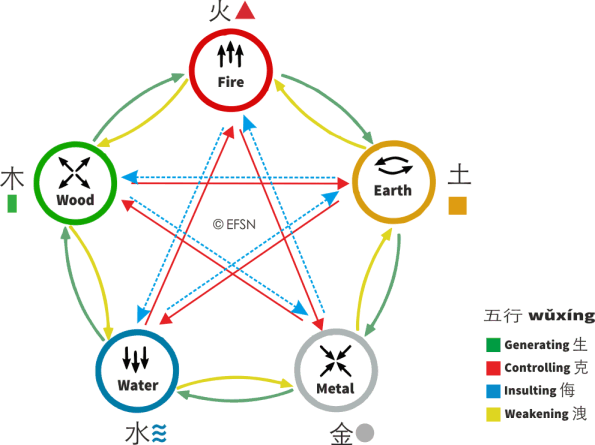
The Five Elements — Wu Xing (五行) — are five phases of Qi: Wood, Fire, Earth, Metal and Water. They are not fixed substances but movements that continuously generate and control one another.
Just as the concepts of Yin and Yang express an energetic duality, like the two poles of a magnet, the five elements represent five distinct phases of Qi (Chi). This theory is a cornerstone of many Chinese disciplines — medicine, the martial arts and feng shui itself. To explain it we turn to five symbolic elements of nature, namely Fire, Earth, Metal, Water and Wood, each one representing a movement, a different transformation of Chi.
It should be said that the original translation of the Chinese term Wu Xing (五行) is not "five elements": it refers rather to five moments or phases of energy, which reminds us not to fall into a merely physical association of the elements. Some authors, such as the sinologist J. M. de Kermadec, refuse to use the inexact term. We have to understand that it is natural for certain gaps to arise from the early adaptation of Chinese philosophy to Western thought, quite apart from the passage of time. By consensus and common usage, we normally speak of the five elements. Let us look at a description of their characteristics.
火 The fire element is related to rising energy, to brightness and to summer; 土 earth to circular movement and therefore to the turning of the cycles; 金 metal to inward movement and the autumn season; 水 water to descending energy, represented by winter; and 木 wood to outward movement and the energy that appears in spring. These are just a few associations, according to movement and the natural seasons.
An extremely rich range of associations comes together in the five elements: fire, for example, relates to summer but also to the heart, to the colour red, to certain emotions such as stress or impatience, and to triangular shapes. Each element forms part of an extensive description that lets us classify spaces by weighing up the kinds of energy that affect them. These relationships make it possible to read, more or less precisely, the events that unfold — or could unfold — in a space.
Chinese theory holds that the five elements must remain in mutual balance. Fire, for instance, serves to give warmth, to cook and to transform raw matter, but in excess it can be a great destroyer; and water, a source of transport and storage, can lead to floods or extreme drought when it falls out of balance.
Feng shui, as a way of reading natural energy, can point out these imbalances and introduce solutions that correct the problem. Consider a house that overuses the metal element and its qualities: uniform white tones, polished and shiny surfaces, metal itself, austere and autumnal décor, extreme order and cleanliness, and so on — all of which can foster an atmosphere lacking joy and warmth, one that might be associated with respiratory or stiffness problems, or with emotional states such as depression and sadness. All of these associations belong to the metal element, and none of them was chosen arbitrarily.
Before drawing up a general table of the compounds formed by the five energies, let us look at a fundamental part of this theory: the different cycles through which the elements interact. Understanding these cycles lets us see how the energies regulate one another in nature, or within a particular environment.
The Generating Cycle — creation (相生)
Each element feeds the next, in a continuous loop.
Also called the cycle of creation, it gives an idea of how one element is helped by another to express itself, and how it then serves as nourishment to create the next, and so on in a continuous cycle. In feng shui it is used to increase or favour the positive qualities of a given space. Consider the whole sequence:
- Wood feeds fire,
- Fire produces earth,
- Earth generates metal,
- Metal produces water,
- Water feeds wood.
Symbolically, wood fuels fire and stokes it; as fire dies down and completes its expression it creates earth (ash), much as a volcanic eruption gives rise to new islands; earth produces metal (mineral ores are drawn from the womb of the earth, in mines and so on); metal, through smelting, generates water (a liquid substance); and finally the water element nourishes wood and makes it grow — the cycle repeating continuously.
Bear in mind that this is a symbolic way of describing the cycle of creation. Most of the elements are easy to grasp through their natural analogies; perhaps the hardest is metal producing water.
The Controlling or "Destructive" Cycle (相克)
Each element keeps another in check.
This cycle shows the way in which one element controls the expression of another. Some texts call it the cycle of destruction, but authors such as Joseph Yu note that the word is not quite exact, since it suggests total annihilation where there is rather a controlling influence: a piece of metal can cut a piece of wood without necessarily destroying it, just as wood can draw life from the earth without consuming it entirely. Consider the full cycle:
- Fire melts metal,
- Metal cuts wood,
- Wood weakens earth,
- Earth dams water,
- Water extinguishes fire.
The controlling cycle is a natural way of keeping the system in check, much like the natural balance in which one fish is eaten by a larger one, which in turn becomes food for a larger still. It allows an overall equilibrium, since every element is both controlled and a controller. When the controlling element exceeds reasonable limits, it can, with all the more reason, turn into something closer to a destructive cycle.
The Weakening or Exhaustion Cycle (相泄)
The reverse of creation: the child exhausts the parent.
Also known as the mother–child relationship, this cycle is the reversal of the cycle of creation and describes how an element — the child — can weaken or exhaust the parent element that produced it. Consider the full sequence:
- Metal weakens earth,
- Earth weakens fire,
- Fire weakens wood,
- Wood weakens water,
- Water weakens metal.
We say, for example, that metal is the child of earth: an excessive extraction or dominance of this element tends to exhaust the earth. We also say that wood is the child of water, meaning that the growth of wood (plants, trees) diminishes the amount of water, and so on with each element. This cycle is a subtler version of the controlling cycle. Its application extends to several feng shui methods, such as the Xuan Kong (Flying Stars) or Ba Zhai (Eight Houses) branches, generally being used to weaken the elements associated with negative stars.
The Insulting or Harm Cycle (相侮)
The reverse of control, active when the system loses balance.
This cycle is the reverse turn of the controlling cycle. D. H. Van Berghe explains how it becomes active when the controlling system loses coherence or falls out of balance. Consider the cycle and an example:
- Wood insults metal,
- Metal insults fire,
- Fire insults water,
- Water insults earth,
- Earth insults wood.
We could say that if the wood is very strong and the metal weak, the metal is harmed and loses its original force when it tries to control or "cut" the wood. The same happens with an intense fire that evaporates water before the water has any chance to control the fire, or with an excess of water that sweeps away the earth, which loses its firmness and stability.
To study the five elements in depth and learn to apply them, take a look at our professional Feng Shui course.