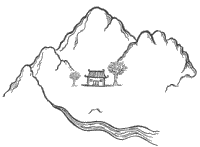
The five celestial animals of feng shui — the Black Turtle (玄武), the Red Phoenix (朱雀), the Green Dragon (青龍), the White Tiger (白虎) and, at the centre, the Yellow Snake — describe the ideal landform around a home: solid support behind, an open outlook in front, and balanced sides.
The Form School constantly refers to a set of symbolic animals that stand for the favourable qualities of a natural site. These animals are the black turtle, the red phoenix, the green dragon, the white tiger and, at the centre, the yellow snake. Each one represents a particular group of characteristics; let us look at them one by one.
THE YELLOW SNAKE
Associated direction: Centre.
Element: Earth.
Colour: Yellow.
We begin with the snake, because it stands for the centre — the point of reference from which the other animals are described. In the theory of the five elements, the colour yellow and the centre belong to the earth element. The snake shares this quality: a highly receptive, sensitive creature that stays alert to all that surrounds it.
Where is the snake? If you are studying your own home, the home is the snake; if you are looking at a building in relation to others, that building is the snake; if you picture yourself surrounded by other buildings, you are the snake. In short, this animal is the virtual centre, which can be surrounded by the four resting animals.
THE RED PHOENIX (朱雀)
Associated direction: South.
Element: Fire.
Colour: Red.
This mythological bird is the counterpart of the turtle: it stands for the facing, the facade, the open outlook that most buildings have. If stillness and protection are the clear marks of the black turtle, the phoenix needs a certain amount of space, an open area in which to receive energy. A telling case of a building without a phoenix is one whose main facade, once built, faces straight onto a mountain, or onto other buildings or structures that block the healthy reception of energy, or Qi.
When a book advises you not to place a tree right in front of your door, it is reminding you to preserve the phoenix. If you feel uneasy with your desk facing a wall, it is for exactly the same reason: human eyes were not made to live in captivity or underground, but to enjoy the open outlook this principle stands for.
A phoenix still keeps to certain principles: while it reflects a broad view, it should draw in the flow of Chi in a controlled way. That is why a facade left entirely open to every influence would not be very safe. The phoenix sits in front of the yellow snake, like a low coffee table before the sofa, or a gentle hill in the distance.
THE WHITE TIGER (白虎)
Associated direction: West.
Element: Metal.
Colour: White.
The tiger stands for strength, energy and daring. In relation to the green dragon, it lies to the right of the yellow snake. It may be a mountain, a building, a wardrobe or a structure, and it holds a somewhat less dominant role than the green dragon.
Some authors explain this by saying that strength must be accompanied by the reflection and wise activity of the dragon. In general, a tiger less strong than the green dragon means giving priority to thought and sound judgement over impulsive decisions based on force alone.
There is some disagreement over which of the two animals should be the more dominant, the tiger or the dragon. In Eva Wong's texts the considerations above are reversed, relating them more specifically to the Yin feng shui of burials, as opposed to the Yang feng shui used for the dwellings of the living.
In any case, the protective presence of both animals on either side of the yellow snake is generally agreed upon — rather like having a good sofa or a comfortable armchair. In the old texts, an arrangement that respects the animals, somewhat in the shape of a horseshoe, favours the settling of Qi or Chi in a given area.
THE BLACK TURTLE (玄武)
Associated direction: North.
Element: Water.
Colour: Black.
This animal embodies something fundamental to good feng shui: protection, solidity and stability. With its shell and apparent stillness, the turtle captures these needs exactly. For a building to enjoy a turtle, it must have something solid at its back — a hill, a group of trees, neighbouring buildings or another structure that shelters it. A turtle protects the back from unexpected currents such as unfavourable winds, an uncontrolled rush of water or other kinds of assault.
A turtle must also keep a harmonious form, since an immense mountain behind the house, with the risk of a landslide or an avalanche of snow or earth, would turn the “animal” into a dangerous one. Feng shui recommends a gentle hill that shelters the building and fulfils its purpose.
For a person we look for the same qualities. Sitting with your back to a door, a corridor or a window through which draughts flow is not the most solid of arrangements. The bodyguard that any important politician relies on is a kind of turtle. There are many more examples, for this is the easiest animal to understand and also the most important. The turtle sits behind the yellow snake.
THE GREEN DRAGON (青龍)
Associated direction: East.
Element: Wood.
Colour: Green.
This animal is perhaps one of the most representative symbols of Chinese art; it is rare to see a celebration without it. Besides being one of the five celestial animals, the term is also used for energy currents: we speak of water dragons for the courses of that element, or of mountain dragons for the channels along which energy flows through a mountain range.
Where does the green dragon appear? It usually lies to the left of the snake, in the form of a hill, a building, a porch, a tree, a wardrobe or any other sheltering structure.
The left side is traditionally associated with intuition — with what we might call tact and feminine wisdom. In the works of Carlos Castaneda the left side was, as the ancient seers described it, the magical side rather than the strictly rational side of a person.
To go on with the green dragon, we must relate it to its partner the white tiger, since the two sides, left and right, hold a relationship that is often described as one of balance between them.
Related: Schools of Feng Shui (the Form School) · The Five Elements · The Feng Shui Compass. To study the landform and the celestial animals in depth, take a look at our professional Feng Shui course.