Feng Shui Numerology 3.90 is completely free and functional. The author certifies that the program is entirely free of viruses, malware, adware or any malicious process. Note: the program runs on Microsoft Windows or macOS (through virtualization / Boot Camp).
The pair of stars most common for the analysis are the water star (very briefly, the one that speaks about the prosperity of the construction, its dynamism, opportunities and yang energy) and the mountain star (which gives us clues about health, reflection, relationships between people and the yin aspects of the energy).
Each of the stars also belongs to a time cycle, as well as to one of the 5 elements classic in Chinese philosophy (fire, earth, metal, water or wood).
There are 81 pairs of classic combinations (mountain-water, water-time, mountain-time) that offer information about various aspects, although their interpretation varies according to the cycles of time and depending on the distribution of the plan and the external forms that surround the structure. Therefore the program should be used in conjunction with a detailed plan and a knowledge of the Xuan Kong Fei Xing technique, for proper analysis.
Year field: refers to the year of construction or structural refurbishment of a housing or building. This data is used to calculate which period a construction belongs to. There are 9 different periods, numbered from 1 to 9, each with a stipulated duration of 20 years. For example, Period 9 — the one currently reigning — runs from February 4, 2024 until February 4, 2044, so all buildings constructed within that interval belong to Period 9.
According to the latitude of the different time zones, the start of the Chinese solar year can range between February 3 and 5 each year. If the construction of your home was completed in a year of cyclical period change (1964, 1984, 2004, 2024, etc.) you must observe the Chinese solar calendar and the time zone of your country to establish the exact moment when the change occurred.
Facing field: refers to the magnetic degrees measured with a compass at the front of the property (0–360 degrees). Facing readings should be taken as accurately as possible, and it is advisable to take several readings at different points to rule out errors caused by ambient magnetic interference, such as metal structures, hidden pipes, electrical cables, etc.
The 360 degrees are divided into 24 sections or mountains of 15 degrees each. If the facing reading falls on a boundary, especially between the third sub-section of one direction and the first of the next (e.g. N3-NE1, NE3-SE1… or S1-S2, N1-N2, etc.), you should consider the possibility of an undefined reading. The software marks the facing and sitting fields in yellow to warn you that you are close to a void or undefined line (depending on the author, these are also called dead lines, enemy lines or diabolical lines).
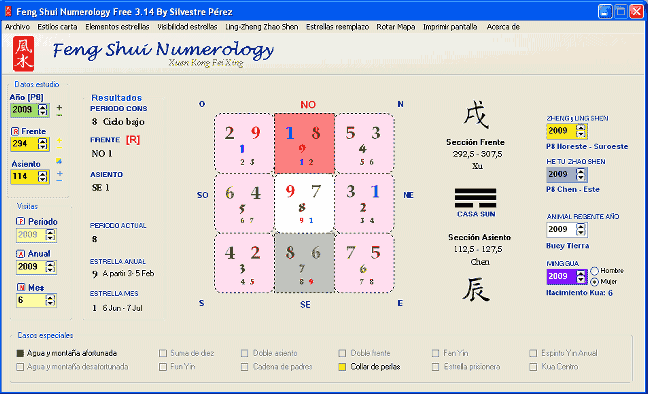
The software allows the calculation of replacement charts, special charts that combine the energy of two different sections or mountains. A red R next to the facing warns that the chart was calculated using this system. The decision to use a special or replacement chart must be checked carefully and with very precise reference data; in practice, the use of replacement star charts is uncommon.
Sitting field: the direction opposite to the front or facing (0–360 degrees). Feng Shui Numerology allows data entry from either the sitting or the facing field, which is helpful in many cases, and the readings can be reversed with a single click.
Current period field: shows the calculation of the influences of the different periods on a fixed chart. A house can retain its original period for decades, and this field lets you place on the chart the energy of the different 20-year periods.
Annual field: shows the calculation of the annual stars and influences, revealing the stars that visit the geomantic chart each year. Remember that the Chinese solar year is used, so the real change does not occur until February 3, 4 or 5 each year.
Month field: calculates the monthly star influences. This field is very useful for studying temporal events in combination with the annual stars. When, in a palace of the chart, the facing or sitting stars coincide with the annual and monthly stars, that moment deserves special consideration in the analysis.
Ruling animal field: shows the astrological animal that governs in the Chinese calendar, useful for some simple calculations applied in feng shui, such as the Peach Blossom.
Ming Gua field: calculates the kua number according to the year of birth. Bear in mind that the Chinese solar year starts around February 3–4. So, if you were born on January 20, 1980, for example, you must enter 1979 for the calculation, since the new Chinese solar year does not officially begin until February 3–5.
He Tu Zhao Shen field: shows the preferred water directions for the different periods. Knowledge of Xuan Kong Fei Xing is required to judge suitability in each case.
Zheng & Ling Shen field: shows the favourable directions for water and mountain in the different periods. Knowledge of Xuan Kong Fei Xing is required to judge suitability in each case.
Version 3.90+ | 2024-04-03
- Automatic scaling for high-resolution 2K and 4K displays
- Dual calculation for the Kua number + East / West groups
- Improvements for Windows 10 and 11
Version 3.19+ | 2021-09-22
- Automatic high-resolution scaling
- Visual improvements
- Updated annual/monthly star calculation for January
Version 3.19 | 2017-03-09
- Annual Jia Zi
- New chart style
- Fixed menu issues on Windows 10
Version 3.14 | 2009-06-09
- Calculations for the favourable water and mountain directions across periods: Ling Shen, Zheng Shen and Zhao Shen directions.
- Kua / Ming Gua number calculation and its relationship with the central palace of the chart.
- Added the special case known in feng shui as the Yin Spirit Formation.
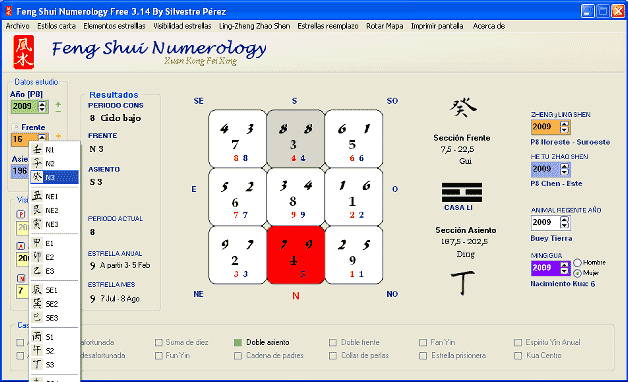
- Data entry via the left mouse button and a pop-up menu containing the 24 mountains.
- Data entry on scales: 15-degree steps for orientation and 20-year steps for the time periods.
- Warning for void lines and the option to calculate star charts using the replacement system.
- Charts can be saved in JPG format, useful for sending charts by email (work, forums, consultations, etc.).
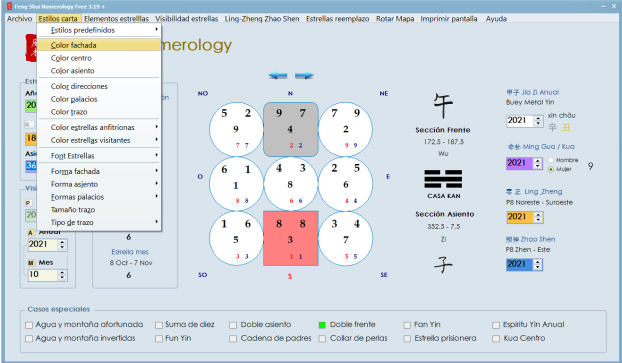
Version 3.0 of Feng Shui Numerology introduced a large number of changes, with the whole visual area of the project completely reprogrammed and many functions added: full map rotation in any direction with the menus or the Ctrl + Right / Ctrl + Left keys, automatic rotation towards the facing with Ctrl + Up, user-programmable visual styles that can be saved to files, and the permanent display of the special cases — an option rarely found in similar programs. This version also shows the Chinese calligraphy of the 24 mountains for each compass section, as well as the trigram of the house using the Ba Zhai system.
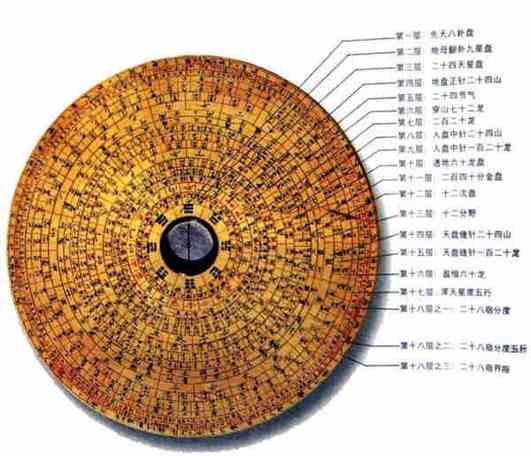
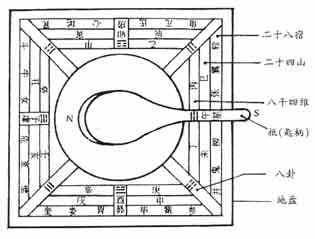
The program provides on-screen the notation in Pinyin of the 24 mountains (intervals used for the reading of the luopan or traditional Chinese compass) and its calligraphy or Chinese characters. To the right of the geomantic chart appears the trigram of the house according to the Ba Zhai school and its relationship with the degrees of the facing and the sittings. In the stars chart the direction that corresponds to the facing is shown in red.
The software gives you the option to program at your convenience the different styles of the projection or Skin, creating different combinations of colors, shapes, fonts, etc.
The software can also optionally display the colors of the element to which each star belongs, by Ctrl + C: (fire in red, earth in brown, metal in grey, water in blue and wood in green).