QI (CHI), THE LIFE ENERGY
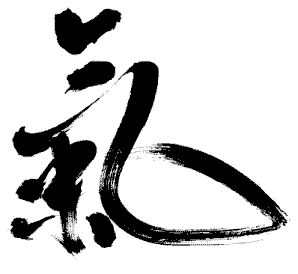
The word Qi, or Chi (氣), appears throughout the Chinese texts on medicine, feng shui, esotericism and the many related arts. It names the life energy that nourishes and sustains everything around us. Other languages have equivalent words — Pneuma in Greek, Ki in Japanese, Prana in Sanskrit — all pointing to a subtle breath that sustains the universe.
For a feng shui master, Qi is an invisible fluid that feeds a space, giving it life and particular qualities. The master's task is to gauge the quality, organisation and distribution of this energy in a given place, weighing its effects and judging whether they are favourable or unfavourable for the intended use. Qi is read through its many earthly forms, natural and man-made, through the cycles of time, and through the influences that mark the directions.
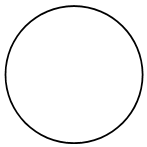
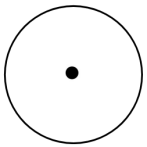
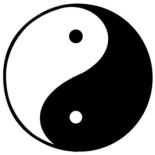
Many Taoist treatises describe the evolution of the universe in energetic terms: the void, or Wu Chi, as an empty circle; then conception (the fertilised egg); and finally the division into Yin and Yang, symbolised in the image of the Tai Chi.
SHENG QI AND SHA QI
Classical feng shui uses the term Sheng Qi for the positive, beneficial side of this energy (places with good feng shui) and Sha Qi for its opposite — unfavourable environments.
The most direct way to sense whether the Qi around you is favourable is to use your own sensitivity and common sense. A place with good feng shui helps people feel well and find harmony in their lives; a place with bad feng shui tends to foster illness, misunderstanding and general disorder. Picture a river of clean, calm water — that is Sheng Qi; now picture a polluted stream, stagnant and turbulent — that is Sha Qi. Like a river, the invisible Qi flows along the directions, the forms and the cycles of time.
On a subtler level, the Qi that suits one person may not suit another. Certain places, orientations, forms or colours can help one person while hindering another. There are general rules for a space and for a person, but they vary with individual temperament — much like exposure to the sun, where some people burn in twenty minutes and others can stay out for hours unharmed, though for anyone the sun in excess is harmful.
Throughout this site you will meet the word Qi, or Chi, again and again. Think of it simply as a way of drawing attention to the fluid that pervades all things and lends them their qualities, both positive and negative.
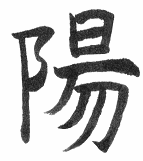
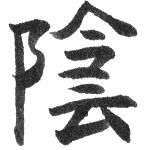
YIN AND YANG (陰陽)
We have looked at Sheng Qi and Sha Qi in general terms. Let us now consider the other “dual” qualities that Qi takes on through its contrasts.
YANG ENERGY stands for activity, movement and light, and so relates to everything that suggests them: the sun, the day, the colour red, a strong voice, stress, wakefulness, life, fire, noise, summer, the masculine, and so on.
YIN ENERGY stands for depth, stillness and darkness, relating to the moon, the night, water, the feminine, the colour black or blue, a soft voice, slow movements, the earth, sleep, the soul, autumn, and so on.
Signs of excessive Yin — some examples:
Symptoms of an overly Yin state can include a lack of mobility, depression, sadness, an unhealthy fondness for darkness, eating only cold food, using grey and dull colours, speaking too softly, keeping to night life, and so on.
As for the space, the remedies might be: increasing the light in certain areas of the home, avoiding obstacles in the layout of the furniture, removing stagnant objects and cluttered storage, choosing bright and cheerful colours, ventilating the space well, not overdoing autumnal pictures and objects (symbolism works in a subtle way), and checking for nearby cemeteries, noisy areas or stagnant water. In short, one looks for a more active, vital dose of energy to create a new balance.
Signs of excessive Yang — some examples:
Symptoms of an overly Yang state might include stress, extreme restlessness, an unbalanced diet of strong foods such as meat, alcohol, seafood or spicy dishes, lack of sleep, overuse of red and harsh colours, the absence of curtains and shelter in the home, music that is too loud, excessive gambling and betting, fast and reckless driving, and so on.
For the space, the advice would be soft, indirect light, pastel shades, curtains that create a sense of privacy, simple bedrooms free of distractions such as a television or computer, calm music, a kitchen with plenty of fruit and vegetables, and quiet surroundings. The aim is to seek positive Yin patterns that restore the balance.
THE TAI CHI (太極)
One of the symbols that best captures the duality and movement of Yin and Yang is the well-known Tai Chi. It is divided into two parts, one white or light (Yang energy) and one black or dark (Yin energy), with a curving line between them, so that as the Yang part grows the Yin part shrinks, and vice versa. Within the Yin part there is a small light circle, showing that deep within Yin energy there is Yang; and within the Yang part a small dark circle, holding Yin. Nothing is ever wholly one or the other.
- Yang Energy
- Light
- Sun
- Man
- Red
- Fire
- Summer
- Open
- Surface
- Fast
- Wakefulness
- Rough
- Noise
- Celebration
- Body
- Yin Energy
- Darkness
- Moon
- Woman
- Blue
- Water
- Winter
- Closed
- Depth
- Paused
- Sleep
- Slow
- Silence
- Prayer
- Spirit
Both Yang and Yin energy are necessary, and between them lie infinite contrasts and degrees. If everything were wholly Yang or wholly Yin there would be no colour in the world, no change; the absence of difference would limit the creativity of the universe.
To know Yang and Yin is to know how to find the balance in the dual sides of our existence. The balance between these forces in a space is exactly what a feng shui practitioner sets out to observe. Feng shui goes further with these dual contrasts when the five elements, or Wu Xing, come into play — another way of giving energy its essential qualities.
Related: The Five Elements · The Feng Shui Compass · The Principles of Feng Shui. To study Qi, Yin and Yang in depth, take a look at our professional Feng Shui course.